The warning was in your logs.
Nobody read it.
Every incident that ever happened on your system had a log entry that came before it. The question is whether anyone saw it in time.
How incidents actually happen
Nobody wakes up to a broken system. It breaks gradually. A plugin update changes an SMTP setting. A migration disables cron. A module introduces a PHP deprecation. A payment callback starts returning bad JSON.
The site keeps loading. Pages render. Uptime monitors show green. The failure is invisible because it happens inside the application, not at the network level.
Days pass. Sometimes weeks. Sometimes months.
Then someone notices. A client calls. A sales team asks why the pipeline is empty. An auditor requests data that doesn’t exist. An editor reports that search returns outdated content.
That’s when someone opens the logs. And there it is. The warning. Timestamped. Clear. It was there the whole time.
Real examples:
Cron stopped 422 days ago. The log entry showing the last successful execution was there on day one. Nobody checked until the database hit 1.8 GB.
Email delivery failed for 23 days. Every failed wp_mail() call was logged with the SMTP error. The contact form kept saying "sent."
501 brute force attempts in 30 minutes. Every failed login was logged with the IP, username, and endpoint. The security plugin blocked most but missed xmlrpc.php.
Search indexing broke for 6 weeks. A PHP deprecation error was logged on the first request after the module update. The error handler suppressed it. Nobody saw it.
Every one of these was in the logs before it became an incident. Every one was preventable.
The problem is not the logs
Logs work. They record what happens. Faithfully, accurately, timestamped.
The problem is that nobody reads them until something is already broken. Logs are treated as forensic evidence - useful after the fact, ignored in real time.
This is not because teams are careless. It’s because reading logs at scale is impossible without automation. A WordPress site generates thousands of events per day. A Vault cluster generates millions. No human can read that. No human should have to.
What if someone was always reading?
That’s what Logystera does. It reads every log event, continuously. It applies pre-built detection rules tuned for WordPress and Drupal. And when a rule matches, it tells you - with the exact evidence.
Not "something might be wrong." Instead: "12 emails failed with SMTP error 550 in the last hour. Here are the log entries."
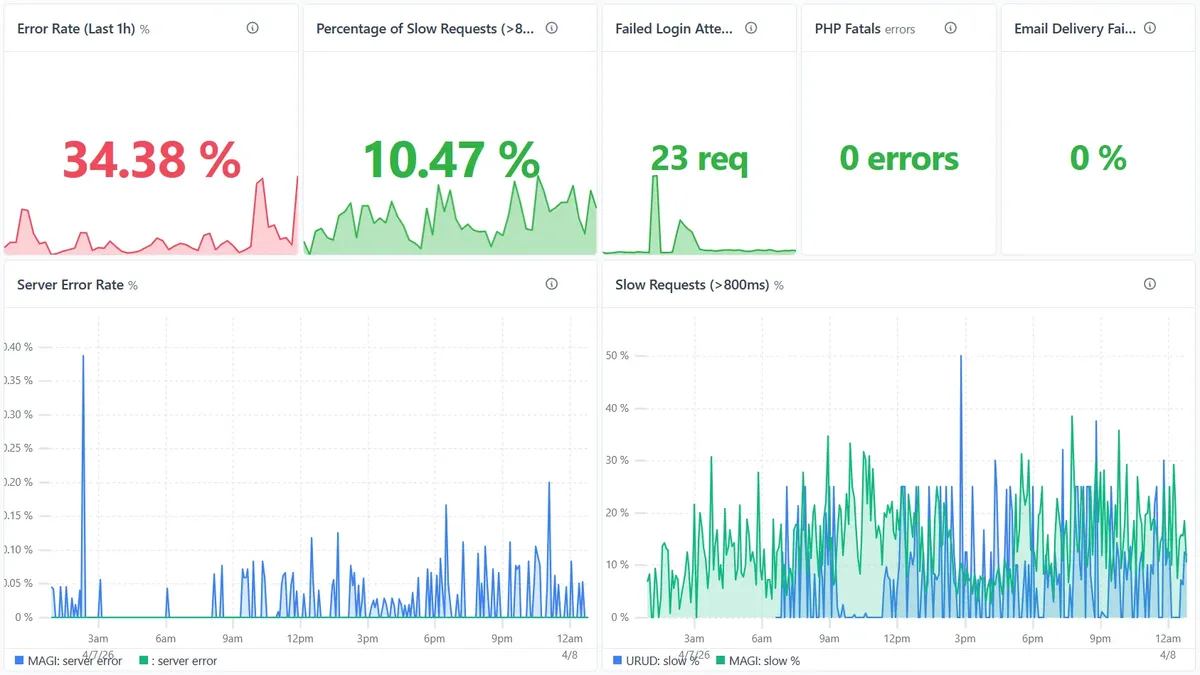
Real failures detected from logs. Error rate, failed logins, email delivery, PHP fatals - visible the moment they happen.
Not after the incident. Before.
Cron stops running? You know within 24 hours, not 14 months. Email delivery drops? You know within an hour, not 3 weeks. A brute force attack starts? You know within minutes, not when an account is compromised.
Why we built this
We saw too many incidents that were preventable. Systems that looked fine from the outside while critical functions were silently broken. Teams spending hours investigating problems that logs had already explained. Audit logs with millions of events and zero analysis.
We built Logystera because we believe the answer to most operational problems is already in your logs. The gap is not information. The gap is that nobody is reading it in time.
Logystera closes that gap.
Every incident was preventable.
The logs said so.
Logystera reads them so you don’t have to.
See it on your systemNow do something about it
See what your own site has been quietly doing.
Install the integration on one site. Within hours, the behavior the homepage describes will either be present on it or not. Either answer is useful.
Free to try on one site. Cancel anytime. No credit card.
